
Pick ABC Lock and Safe as a preferred source on Google
A lot of people think a slamming door means the closer is worn out and has to go. Most of the time it does not. National Lock Supply, a hardware seller, says adjustment solves 80% of closer complaints. A small turn of the right valve is usually all it takes, and the one sure reason to replace the closer is oil on the body or the floor. We work on commercial doors across Portland, and this guide shows you which valve to touch, how far to turn it, and when to stop.
What Matters
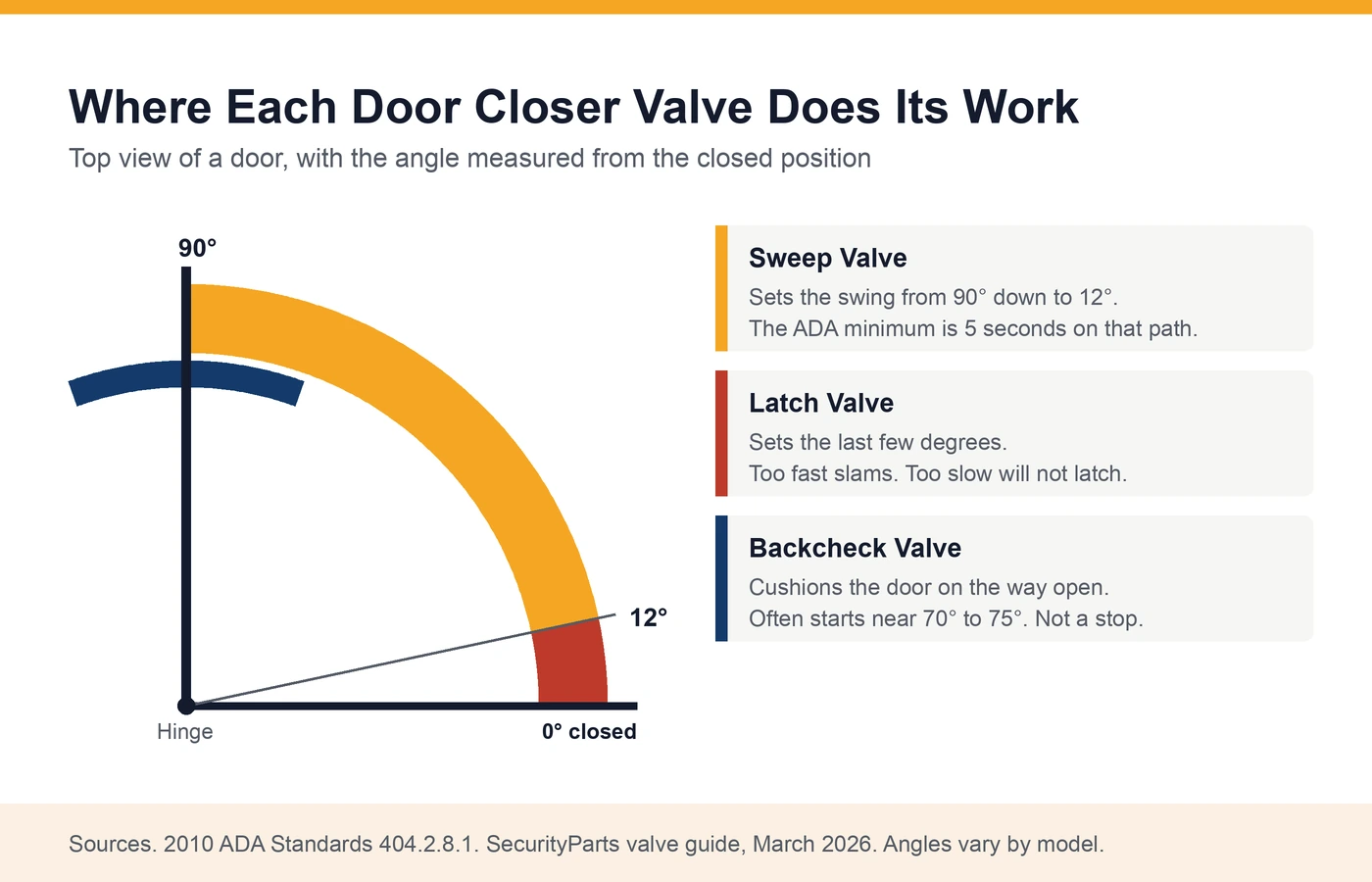
- Three valves do three jobs. Sweep sets the main swing. Latch sets the last few degrees. Backcheck cushions the door on the way open.
- Turn in small steps. An eighth to a quarter turn is enough. Test the door after each one.
- Never back a valve all the way out. The closer will leak, and a leaking closer is finished.
- Time the door with a stopwatch. The ADA minimum is 5 seconds from 90 degrees open to 12 degrees from the latch.
- A heavy door is a spring problem. The valves change speed. They do not change how hard the door is to push.
- Fire doors have to close and latch. Never wedge one or slow it so much that it stops short.
Which Valve to Turn for Each Problem
Find what your door is doing, then go to that valve. Most closers mark the valves with letters or a small label. Check the sheet for your model, because the layout changes from brand to brand.
| What the door does | What controls it | Which way to turn |
|---|---|---|
| Slams in the last few inches | Latch valve | Clockwise, to slow it |
| Swings shut too fast the whole way | Sweep valve | Clockwise, to slow it |
| Stops short and will not latch | Latch valve, after you check the strike | Counterclockwise, to speed it up |
| Takes far too long to close | Sweep valve | Counterclockwise, to speed it up |
| Wind grabs it and throws it open | Backcheck valve | Clockwise, for more cushion |
| Feels too heavy to push open | Spring power, not a valve | Counterclockwise on many models, to reduce it |
The turn directions come from the install sheet for the Hampton BC4031 closer. SecurityParts gives the same directions for sweep and latch. One more case is easy to miss. If the door closes and then bounces back open, National Lock Supply says the backcheck may be set too firm, so back it off a little.
How to Adjust a Door Closer Without Hurting It
Check the door before you touch a valve. A valve cannot cure a door that is hanging wrong.
- Look at the door first. SecurityParts says to check the hinges and the door level, since a sagging door pulls the latch out of line with the strike. Check that the arm sits about square to the door and frame when the door is open at 90 degrees.
- Look for oil. Oil on the closer, the frame or the floor means stop here and go to the replace section.
- Start with the sweep. National Lock Supply sets sweep first, then latch, then backcheck. Each one changes how the next one feels.
- Make a small turn. SecurityParts uses an eighth of a turn. National Lock Supply uses a quarter. Start with the smaller one.
- Open and close the door a few times. National Lock Supply says to wait five cycles between changes so the fluid settles.
- Time it, and write it down. Use the stopwatch on your phone. A note on the settings saves time on the next call.
The Hampton sheet warns not to back the valves out of the closer or a leak will result. National Lock Supply warns that overtightening strips the seat and causes a permanent leak. Stop when the valve feels firm, and stop when it feels loose.
On that same Hampton sheet, the backcheck valve carries its own warning. Never close it completely, because it is not meant to work as a positive stop. It slows a door down. It will not hold one back from hitting a wall.
Time the Door the Right Way
The ADA rule is short. From 90 degrees open, section 404.2.8.1 of the 2010 Standards says the door must take at least 5 seconds to reach 12 degrees from the latch. Lori Greene at iDigHardware notes that a longer time is fine too.
Two common shortcuts can put you under that number.
First, the end point. Some guides tell you to stop the clock about 3 inches from the frame. Run the math on a standard 36 inch door. At 12 degrees, simple geometry puts the latch edge about 7 1/2 inches from the closed spot. A timer that runs on to 3 inches counts extra time, so a door can look legal when it is not. Put a piece of tape on the floor 7 1/2 inches out and stop the clock there. A narrower door has a slightly shorter mark.
Second, the box. The Hampton sheet says to set closing time between 4 and 6 seconds from 90 degrees. National Lock Supply gives 4 to 6 seconds for exterior doors. A 4 second door is fine for many back doors, but it misses the 5 second ADA minimum where that rule applies. The Hampton sheet also says doors used by older people, small children or people with disabilities may need longer times.
The ADA force limit is a separate check. Section 404.2.9 caps the push or pull on interior hinged doors at 5 pounds, and it leaves fire doors to the local authority. SecurityParts says spring size, not the valves, is what lowers that force. Businesses open to the public also have a duty under 28 CFR 36.211 to keep required accessible features in working order. Short breaks for repairs are allowed.
What East Wind Does to Portland Doors
National guides leave this out. Wind hits doors here in a pattern.
Strong east wind blows out of the Columbia River Gorge and into the east side of the metro. In January 2026, KATU reported a wind advisory with gusts up to 40 mph, strongest along I-84 through Troutdale, Fairview and Gresham. Weeks later, KATU reported gusts over 60 mph at Corbett.
A door that faces east takes that hit on the open side. Three things help.
- Add backcheck. National Lock Supply says to always use it on exterior doors in windy places.
- Check the closer size. The Hampton chart puts a size 4 closer on an interior door up to 48 inches wide, but an exterior door only up to 36 inches. A closer that is fine indoors can be too weak on the street side.
- Add a real stop. Backcheck is a cushion. If the wind keeps slamming the door into the wall or bending the arm, the door needs a stop as well.
Heat and cold matter too. SecurityParts and National Lock Supply both say closer fluid thickens in the cold and thins in the heat, and both suggest a check as seasons change. Portland hit 116 degrees on June 28, 2021, says NOAA. A door that behaved in March can act very differently on a day like that. Time your door again each fall, before the wind season starts.
Fire Doors Follow Different Rules
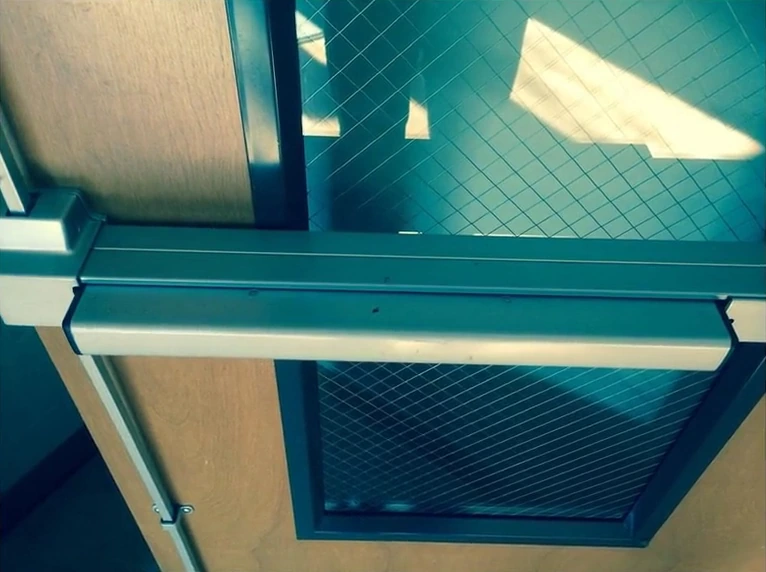
This real job photo from ABC Lock and Safe shows a commercial door with wire glass and a push bar. Doors like this are where closer settings matter most. If you do not know whether a door is fire rated, ask your building manager before you change anything.
A fire door has one job in a fire. LCN, a closer maker, says it must be closed and latched to work. So a closer that stops the door short is a safety problem, even if the door looks fine.
- Do not wedge it. Fire safety writer Brad Keyes says a rated door may not be wedged open, because NFPA 80 calls for self closing devices.
- Do not defeat the closer. Lori Greene explains that a wood wedge or other hold open that does not meet code can let smoke and flames spread.
- Check after the change. Open the door all the way, let go, and watch it close and latch by itself.
Doors on new work also fall under the state code. Oregon's Building Codes Division lists the 2025 Oregon Structural Specialty Code as current, with its use required from April 1, 2026. Your building official has the final say on a permitted job.
When to Replace It Instead
Some closers are past saving. Adjusting them only wastes your time.
| What you see | What it means |
|---|---|
| Oil on the body, floor or frame | Replace it. Seals and cracked bodies are not a field repair. |
| A valve turns and nothing changes | The closer has stopped responding. Replace it. |
| Sweep valve open and the door still slams | Likely fluid loss. Replace it. |
| Bent arm or metal fatigue | Replace the arm or the closer. |
| Loose or rattly arm | Worn spindle or shoe. Have it checked. |
| Over 20 years old on a busy outside door | Time to plan a new one. |
These signs come from National Lock Supply and SecurityParts. Oil is the one to take seriously today. An article in Buildings magazine by an LCN product manager explains that dripping oil can make a floor very slick, and that a closer that loses its oil can let the door swing free. It also says worn seals and cracked bodies cannot be fixed on site. Automatic Door and Hardware gives the same advice, replace it right away.
A storm door at home is a different part. It uses a small tube closer rather than a sealed hydraulic body, so these valve steps will not match it.
Still Not Closing Right?
ABC Lock and Safe has worked on Portland doors since 1985. Door closers, push bars, commercial deadbolts and ADA hardware are all part of our commercial locksmith service, and you get the price on the phone first. We also serve businesses in Gresham and Troutdale, right where the east wind hits hardest.
Door slamming, sticking or leaking oil? Call (503) 766-5541.
Pages Cited
National Lock Supply, Commercial Door Closer Adjustment and Sizing Guide, November 2026
SecurityParts, How to Adjust a Commercial Door Closer, November 2026
Hampton Products, Model BC4031 or BC4032 Installation Instructions, November 2026
2010 ADA Standards, 404.2.8 Closing Speed, November 2026
2010 ADA Standards, 404.2.9 Door and Gate Opening Force, November 2026
Cornell Legal Information Institute, 28 CFR 36.211, November 2026
iDigHardware, Decoded Door and Gate Closing Speed, November 2026
iDigHardware, Operation of Self Closing, Automatic Closing and Power Operated Fire Doors, November 2026
Allegion LCN, Door Closers for Fire Rated Doors, November 2026
Healthcare Facilities Today, Doors Wedged Open, November 2026
Buildings, Watch Out for Leaking Door Closers, November 2026
Automatic Door and Hardware, Addressing Velocity and Oil Leaks, November 2026
KATU, Wind Advisory for East Portland Metro, November 2026
KATU, Gusty Winds Near the Gorge, November 2026
NOAA Climate.gov, June 2021 Pacific Northwest Heat Records, November 2026
Oregon Building Codes Division, Adopted Codes, November 2026