
Pick ABC Lock and Safe as a preferred source on Google
A lot of people think the lock on an old front door is just a fancy knob set that any new lock can replace in an afternoon. It is not. A mortise lock lives in a deep pocket cut into the edge of the door, and PDQ, a lock maker, puts that steel case at 3 to 5 inches deep. A regular cylindrical lock sits in round holes drilled through the face of the door. The two do not swap without door work. We open, repair and rekey both kinds across Portland, and the guide below shows you how to tell which one you have before you buy anything.
What Matters
- Look at the door edge. A tall, thin plate with a latch and a bolt in one strip means a mortise lock. A small round latch plate means a cylindrical lock.
- The two are not swappable. A cylindrical lock needs bored holes. A mortise lock needs a pocket. Going from one to the other takes door work.
- Old Portland homes have plenty of them. About 27% of Portland housing was built in 1939 or earlier.
- A skeleton key lock is low security. The old warded locks that take those keys stop very little.
- Most old mortise locks can be saved. Springs, dirt and a door out of line cause most trouble, and all three can be fixed.
- Smart locks need a special model. A standard smart deadbolt is made for bored doors, not mortise doors.
Mortise vs Cylindrical in One Table
Both lock a door. They get there in very different ways.
| Feature | Mortise lock | Cylindrical lock |
|---|---|---|
| Where it sits | In a rectangular pocket cut into the door edge | In round holes bored through the door face and edge |
| Latch and bolt | Often both in one steel case | Knob latch, with a separate deadbolt above it |
| What you see on the edge | One tall, thin faceplate held by two screws | A small latch plate, plus a second plate for the deadbolt |
| Door it needs | Usually a solid door, 1 3/4 inches thick as the standard | Most standard doors, often 1 3/8 to 1 3/4 inches |
| Install | Pocket routed or chiseled, best left to a pro | Drop in if the holes are already there |
| Cost | Usually more for parts and labor | Usually less |
| Where you see it | Older homes and busy commercial buildings | Most newer homes |
The case depth and door size come from PDQ's mortise lock guide. The 1 3/8 to 1 3/4 inch range is from Schlage's spec page for its Encode deadbolt, a common bored lock. Door hardware maker Emtek notes that mortise locks usually cost more and need a pro to cut the pocket.
How to Tell Which Lock Your Door Has
Open the door and look at the edge. That takes ten seconds and answers most of the question.
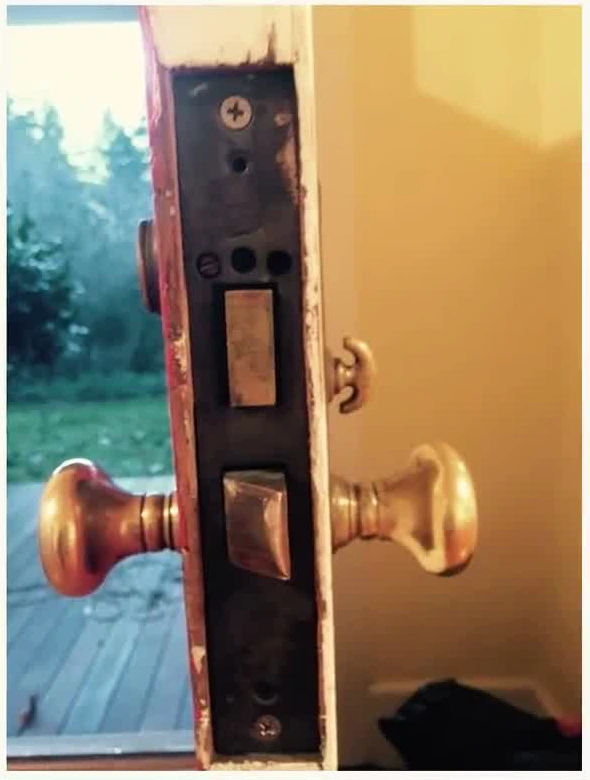
This photo is a mortise lock. See the long faceplate down the door edge? The square bolt sits up top and the angled latch sits below it, both in one plate. The brass knobs and the thumb turn all feed into that one hidden case.
- Check the faceplate. A tall, narrow plate with two screws, one near each end, points to a mortise lock. PDQ lists that plate as the first sign.
- Count the holes. A cylindrical setup has a round knob and a separate deadbolt above it, each in its own hole.
- Look at the trim. Mortise locks often have a tall plate on the door face, called an escutcheon, with the knob and keyhole on it. Bored locks usually have small round roses.
- Find the keyhole. A keyhole shaped like an old skeleton key, or a round key cylinder screwed into the plate above the knob, often point to a mortise lock.
- Feel the weight. If the lock is off the door, a mortise case is a heavy steel box. PDQ puts most at 3.5 to 4.5 inches tall.
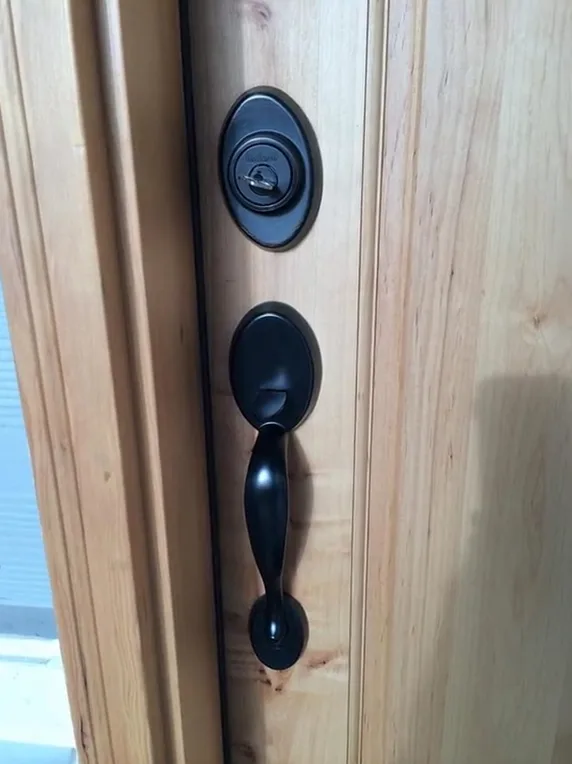
This one is the bored kind. The deadbolt has its own round hole above the handle. Each part can come off and go back on with a screwdriver. That is why most new lock boxes on a store shelf are made for doors like this one.
Why So Many Old Portland Doors Still Have One

Portland is an old city. The NeighborhoodScout real estate page for Portland, built on American Community Survey data for 2024, puts 26.82% of the city's housing at 1939 or earlier. Another 26.47% went up from 1940 to 1969.
That matters because a mortise lock was a mark of a quality door in that era. This Old House calls them a hallmark of older, well made doors. Wikipedia's history of the mortise lock notes that Linus Yale Jr. brought out a pin tumbler cylinder for mortise locks in 1865, and that kind of cylinder is still the most common today.
So a bungalow or a foursquare in Northeast Portland may have a 100 year old mortise lock on the front door and skeleton key locks on the bedroom doors. A newer house is more likely to have bored locks. Knowing which you have saves you a wasted trip to the store.
The Skeleton Key Problem
Many old mortise locks take a skeleton key. Those are warded locks. Inside sit fixed bumps, called wards, and only a key with the right notches can turn past them.
That sounds fine until you read the fine print. Wikipedia's page on warded locks says a well made skeleton key can bypass the wards, and that these locks are used for low security only. There are only so many key shapes, so one key often opens many doors.
On a bedroom or a closet, that is fine. On an outside door, it is not enough. You have three good choices.
- Add a deadbolt. Keep the old lock for looks and add a modern deadbolt above it for security.
- Upgrade the mortise lock. Some old cases can take a modern key cylinder. Others need a new mortise lock that fits the same pocket.
- Convert the door. Fill or cover the pocket and fit bored hardware. This takes the most work.
Repair, Rekey or Replace an Old Mortise Lock
A lot of old mortise locks are not broken. They are dirty, dry or out of line. This Old House's mortise lockset repair guide lists the usual failures.
- A broken or weak spring, most often the one that pulls the latch back.
- Bent or rusted levers inside the case.
- Loose parts floating in the box.
- A worn latch, bolt or thumb turn.
- Keys that no longer work, and knobs that spin or stick.
The same guide says to use powdered graphite in the keyway, not a spray oil, since spray collects dust inside the lock. It puts the full job at about 3 hours and rates the skill at 3 out of 5. It also says to call a locksmith when the cylinder seizes, when the hardware is antique, or when the parts are hard to find.
Check the door before you blame the lock. If the latch rubs the strike plate, the lock will feel stiff no matter how clean it is. Old wood doors swell in the wet months, so a door that worked in August can bind in January.
Rekeying works on a mortise lock that takes a modern pin tumbler cylinder. The cylinder comes out, gets new pins, and goes back in. Your old keys stop working. A skeleton key lock has no pins to change, so rekeying it is not an option. The guide to rekeying a lock covers how the pin swap works.
Can You Swap a Mortise Lock for a Regular Lock?
Yes, but it is a door job, not a lock job. PDQ says plainly that a bored lock cannot drop into a mortise pocket, and a mortise lock cannot drop into bored holes.
To go from mortise to bored, the pocket has to be filled or covered, and new holes drilled. To go from bored to mortise, a pocket has to be cut. Wikipedia points out that cutting a mortise weakens a typical wood door, which is why reinforcing plates exist to cover the area.
If you like the look of your old door, the easier path is often a new mortise lock that fits the pocket you already have. Bring the old case or a photo of the faceplate with its size when you shop.
Smart Locks and Mortise Doors
A standard smart deadbolt is made for bored doors. Schlage's Encode page says it fits standard doors from 1 3/8 to 1 3/4 inches thick with a 2 3/8 or 2 3/4 inch backset. It says nothing about mortise doors.
Smart locks built for mortise doors do exist. Security Systems News reported in August 2024 that Alfred launched its ML2 smart mortise lock in the U.S. as a retrofit for older mortise style locks, with a keypad and app control. Check the maker's fit list against your lock before you buy. The seven smart lock checks for Portland doors cover the Wi-Fi, battery and weather questions for any model.
Why Businesses Still Pick Mortise Locks
Wikipedia notes that mortise locks are common in commercial and institutional buildings. There is a reason. Mortise locks have their own lab standard, ANSI/BHMA A156.13. PDQ says Grade 1 under that standard means at least 1 million test cycles, the level for busy commercial doors. Emtek adds that many mortise locks carry anti saw inserts and an anti pick latch that tubular locks lack.
PDQ lists 1 3/4 inches as the standard door thickness and 2 3/4 inches as the standard backset for commercial mortise locks. PDQ also says a mortise lock packs more functions into one case than a bored lock, which usually does one job per lockset.
The door still matters. This Old House says to line up the door and the strike plate before you judge the lock, and that holds for a shop door as much as a front door.
Keep the Old Lock or Move On
Most old mortise locks are worth keeping on inside doors and worth upgrading on outside doors. Clean it, free up the door, and add real security where it counts.
ABC Lock and Safe has worked on Portland doors since 1985. We repair sticking locks, rekey old and new hardware, install deadbolts and high security cylinders, and service commercial door hardware. You get the price on the phone first. See our residential locksmith service for homes, or our commercial locksmith service for offices and storefronts.
Not sure what lock is on your door? Call (503) 766-5541.
Pages Cited
PDQ, How to Identify a Commercial Mortise Lock, November 2026
Emtek, Mortise vs Tubular Locks, November 2026
This Old House, Fixing a Mortise Lockset, November 2026
Wikipedia, Mortise Lock, November 2026
Wikipedia, Warded Lock, November 2026
NeighborhoodScout, Portland, OR Real Estate and Housing Data, November 2026
Schlage, Encode Smart WiFi Deadbolt BE489 Specifications, November 2026
Security Systems News, Alfred International Launches Smart Mortise Lock in U.S., November 2026