
Pick ABC Lock and Safe as a preferred source on Google
Most people reach for WD-40 when a deadbolt gets hard to lock. The US Forest Service tells its own staff not to. Its physical security guide says petroleum sprays hold on to dust inside a lock core. And in a wet Portland winter, the lock is often not the problem at all. The wood door around it swells, the bolt starts to rub the strike, and the key takes the blame. We fix stuck deadbolts all over Portland, and this is the first thing we check.
What Matters
- Test with the door open first. If the bolt turns easily open but fights you closed, the door is out of line, not the lock.
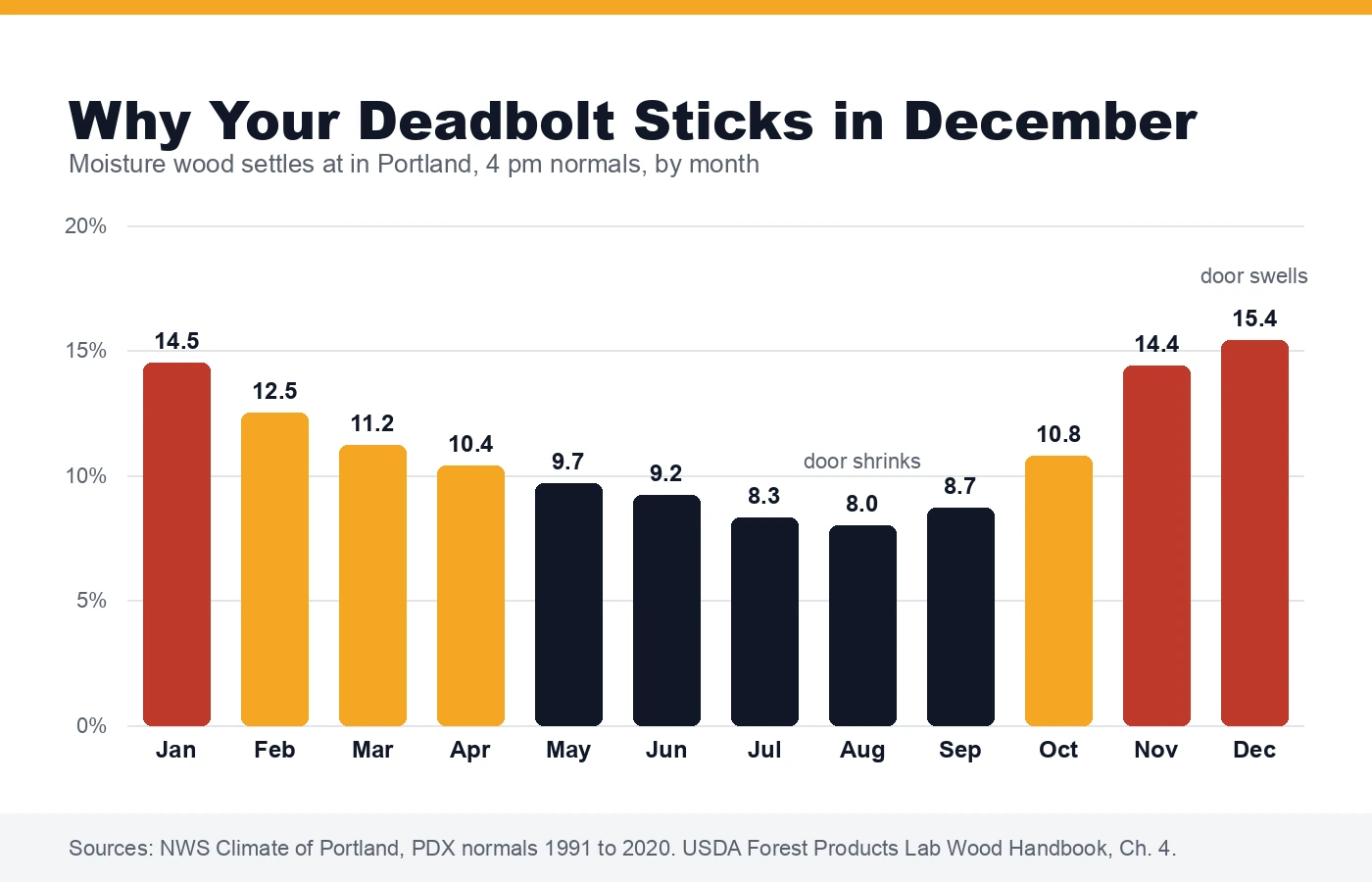
- Portland wood takes on water in winter. At normal 4 pm humidity, wood settles near 8 percent moisture in August and over 15 percent in December.
- The bolt rubbing the strike is the most common cause. A lipstick mark on the bolt shows exactly where it hits.
- Skip oil sprays. Use graphite, silicone or a PTFE spray made for locks.
- Never force the key. A bent or snapped key turns a small job into a bigger one.
The Ten Second Test, Door Open or Door Closed
Open the door. Turn the key or thumb turn and throw the bolt all the way out, then pull it back.
That one test splits every stuck deadbolt into two groups.
- Smooth with the door open, stiff with it closed. The lock works. The bolt is hitting the strike plate or the hole behind it. Go to causes 1 to 3.
- Stiff both ways. The problem is inside the deadbolt. Go to causes 4 to 6.
Try one more thing with the door closed. Push the door in hard toward the stop, or lift up on the knob, and turn the key again. If it suddenly turns easily, you just proved the bolt and the strike are out of line.
Why Portland Doors Move When the Rain Comes Back
Wood soaks up water from the air and swells, then dries and shrinks. The USDA Forest Products Laboratory Wood Handbook says wood moves most along the growth rings, about half as much across them, and only a little along the grain. So a door and its frame get wider and fatter in wet months, not taller.
For coast type Douglas fir, the wood the handbook defines as grown in Oregon and Washington west of the Cascades, it lists shrinkage from green to oven dry of 7.6 percent along the rings and 4.8 percent across them. A wood door and jamb never swing that far in a house. But it does not take much movement to push a bolt off its hole.
The weather explains the timing. The National Weather Service normals for Portland International Airport put the 4 pm humidity at 43 percent in August and 77 percent in December. We ran those numbers through the moisture equation in the Wood Handbook, using the normal high for each month. The result is the chart above.
| Month | PDX humidity at 4 pm | Normal high | Wood moisture it settles at |
|---|---|---|---|
| August | 43% | 82.3°F | About 8.0% |
| October | 59% | 69.4°F | About 10.8% |
| November | 74% | 53.5°F | About 14.4% |
| December | 77% | 46.9°F | About 15.4% |
| January | 74% | 47.5°F | About 14.5% |
That is nearly double from late summer to early winter. The handbook also says short swings in the weather mostly change the surface of the wood. So one rainy day will not do it. It is the long wet season, and the chart shows the big jump comes in November.
The other half of the story is August. A strike plate set in a dry month can fit perfectly and still bind by Thanksgiving.
Six Causes and What Each One Needs
1. The Bolt Rubs the Strike Plate
This is the big one. Rub lipstick, chalk or a dry erase marker on the end of the bolt. Pull the bolt back, close the door gently, and turn the key. Open the door and look at the strike. The mark shows where the bolt hits.
- A small mark on one edge. File that edge of the strike opening a little at a time with a metal file.
- The bolt misses by more than a file can fix. The strike plate has to move up, down or sideways, and the old screw holes need to be filled so the new ones hold.
2. Loose or Sagging Hinges
A heavy wet door pulls on its top hinge. Once those screws loosen, the latch side drops and the bolt hits the bottom of the strike. Tighten every hinge screw first. If one spins and never grips, a longer screw that reaches the wall stud behind the jamb will pull the door back up. Do this before you touch the strike, or you may file it for a problem that was never there.
3. The Hole Behind the Strike Is Too Shallow or Full
A deadbolt needs room to throw all the way out. If the hole in the jamb behind the strike is shallow, or packed with paint, wood chips or old caulk, the bolt stops short. A bolt that does not fully extend can feel stuck and also may not lock in place. Shine a light in the hole. Clean it out, or have it drilled deeper.
4. A Dirty or Dry Cylinder
If the key is stiff even with the door open, the pins inside may be gummed up. University of Georgia Extension suggests silicone, PTFE or graphite for sticky locks, and warns that oil based sprays pull in dust. One short puff in the keyway, then work the key in and out a few times.
If someone already sprayed WD-40 in there, the Forest Service guide says it does work as a cleaner. Just put a proper lock lubricant in right after.
5. The Deadbolt Is Screwed On Too Tight
The two long screws that hold the inside thumb turn to the outside half can pinch the bolt if they are cranked down hard, or if the two halves sit a little crooked. Loosen them a half turn, work the bolt, and snug them back down evenly. If the bolt gets smoother, you found it.
6. A Worn Key or a Worn Lock
A copy of a copy of a key wears down. So does a cylinder that has been turned twice a day for many years. If a fresh key from a good original fixes it, you are done. If the cylinder itself is worn, it can often be rekeyed or swapped without replacing the whole deadbolt. Our guide to rekeying a lock covers what that involves.
Match the Symptom to the Cause
| What you feel | Likely cause | Try first |
|---|---|---|
| Turns easily only when you push or lift the door | Bolt rubs the strike | Lipstick test, then file the strike |
| Door rubs the frame near the top on the latch side | Sagging hinges | Tighten the top hinge screws |
| Bolt stops short of fully out | Shallow or packed bolt hole | Clean the hole behind the strike |
| Key is stiff even with the door open | Dirty or dry cylinder | Graphite, silicone or PTFE spray |
| Thumb turn is stiff even with the door open | Deadbolt screwed on too tight | Loosen and evenly snug the two screws |
| One key is hard, another works | Worn key | Use the best key, get a new one cut |
Three Things That Make It Worse
Forcing the key. A key twisted hard against a binding bolt can bend or snap off in the cylinder. Then you need the broken piece pulled out before anything else can happen.
Oil and nothing else. It feels better for a while. Then the dust it collects makes the lock stiffer than before.
Planing the door in December. Shaving a swollen door to fit the wettest month can leave a gap and a loose bolt when it dries out next summer. Fix the hinges and the strike first. Paint any bare wood you do cut, since the Wood Handbook says paint slows moisture change even though it cannot stop it.
When the Door Still Will Not Lock
A door that will not lock at night is a security problem, not a chore for the weekend. ABC Lock and Safe has worked from Northeast Portland since 1985, and stuck deadbolts, strike plate repair and broken key extraction are all on our service list. We repair most locks that stick or wear out, and replace one only when it is broken past repair or you want something new. We are open 24/7, you get the price on the phone first, and we typically reach you in 15 to 30 minutes. See our residential locksmith service for the full list, and if your house has an older mortise lock, read mortise lock vs cylindrical lock first.
Deadbolt fighting you tonight? Call (503) 766-5541, 24/7.
Pages Cited
USDA Forest Service, Electronic Physical Security Toolbox, November 2026
UGA Cooperative Extension, Home Maintenance Quick Fix, November 2026
USDA Forest Products Laboratory, Wood Handbook Chapter 4, Moisture Relations, November 2026
National Weather Service, Climate of Portland, Airport Normals 1991 to 2020, November 2026