
Pick ABC Lock and Safe as a preferred source on Google
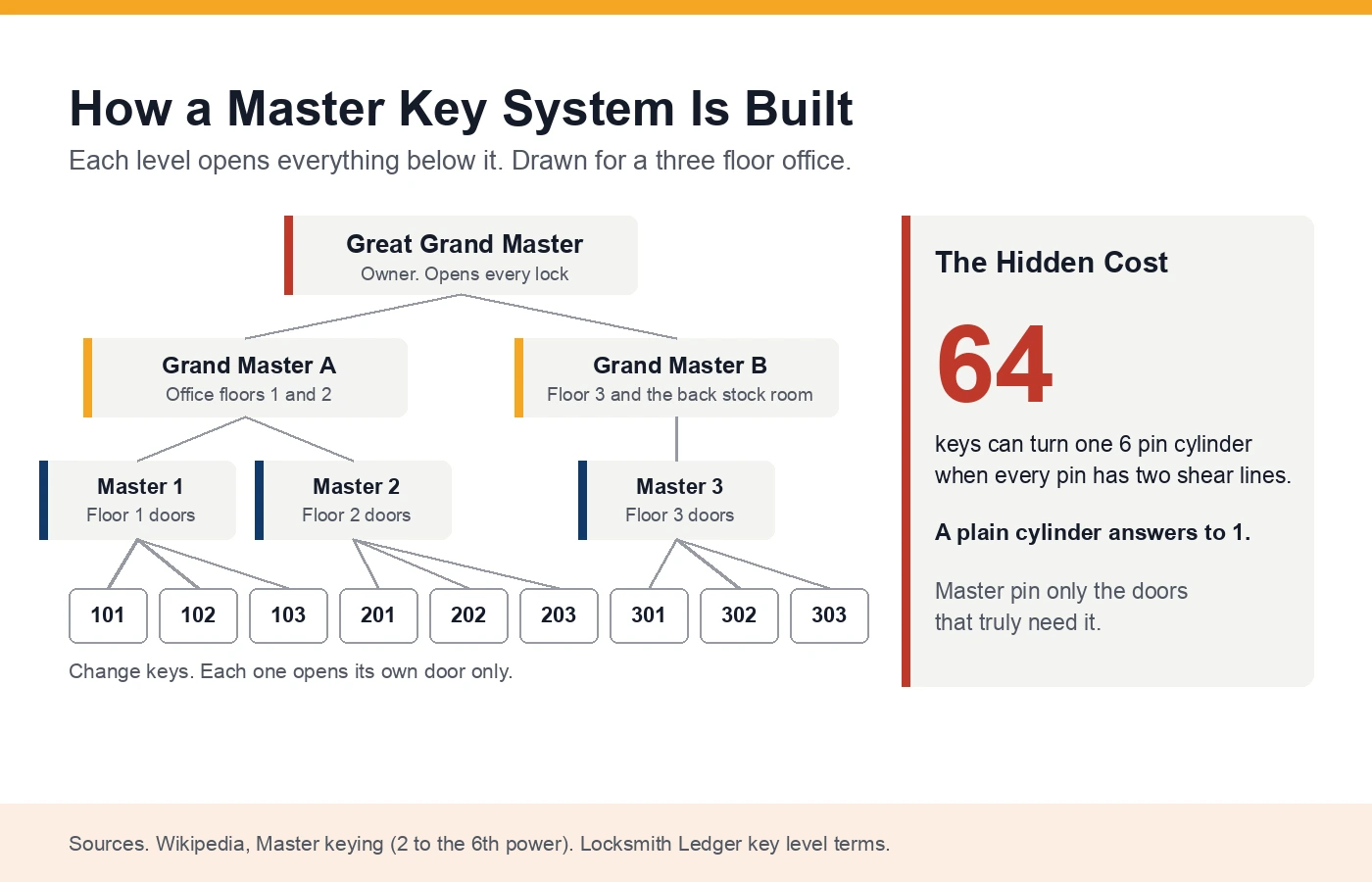
A lot of owners think a master key system is simply one handy key that opens every door, with no downside. That is not how the lock sees it. To let two keys turn the same cylinder, the locksmith adds a small extra pin in each chamber, and Wikipedia's entry on master keying shows the cost. A six pin cylinder built for one key can be turned by up to 64 keys when every chamber has two shear lines. We set up master key systems for Portland businesses, and this guide covers the seven mistakes that turn a good system into a weak one.
What Matters
- Every master pin opens a door wider. Each one lets more key cuts turn the lock, so use them only where you need them.
- Keep outside doors on their own keys. Or put them on a card or code system instead.
- A copyable keyway undoes the whole plan. A restricted keyway keeps blanks out of the hardware store.
- Records are part of the system. Write down who holds which key, and who can order more.
- One lock and one change key can give up the master. A security researcher proved it in 2003 with a few blanks and a file.
- A lost top master means a full rekey. A lost change key usually means one cylinder.
How a Master Key System Works
A normal pin lock has one line inside it where the pins must line up for the plug to turn. A master keyed lock has two lines in some chambers. One fits the door's own key. The other fits the master. Wikipedia notes that master keying in general lowers security, since the extra lines give a picker more ways in and let more keys work.
Keys come in levels. A 2008 Locksmith Ledger piece by Rod Oden calls the top one the TMK, or top master key, with sub masters and change keys below it. Each level opens everything under it.
| Key level | What it opens | Who usually holds it |
|---|---|---|
| Great grand master | Every lock in the system | The owner, kept locked away |
| Grand master | A whole group of masters, like a building | Property or facility manager |
| Master | One floor, wing or department | Supervisor or cleaning crew lead |
| Change key | One door only | The person who works or lives there |
Small shops often need only two levels, a master and change keys. Each extra level adds more master pins, so add levels only when a real person needs them.
There is plenty of room for change keys. Gale Johnson, editor emeritus of Locksmith Ledger, wrote in 2017 that one common layout gives 4,096 change keys on paper for a six pin lock. He adds that the real number runs about 10% lower once cut limits are applied.
Seven Mistakes That Weaken a Master Key System
1. Mastering Every Door, Even the Outside Ones
The front door, back door and loading door face the street. Every master pin in them gives an outsider more keys that could work. A 2003 Locksmith Ledger article, The Case Against Master Keying, says to put master pins only where they are needed. It also suggests keying outside doors differently or adding a second access system on them.
Keep the street doors simple. Give them their own key, or put them on a keypad or card reader you can change in a minute.
2. Using a Keyway Anyone Can Copy
A master key cut on a common blank can be copied at many key counters. That one copy can open every door in the building.
A restricted keyway closes that gap. Schlage says its Everest 29 R and T keyways are restricted. The blanks are tightly controlled, the key design is patent protected until 2029, and only authorized dealers and end users can get them. Its S keyways are not restricted. Ask which family you are buying before the system is built, not after.
3. Keeping No Records of Who Holds What
A master key system without records is a guess. Rod Oden lists what good records cover. Who can order keys and rekeying, who approves the plan, who keeps the records, how lost keys get replaced, and how returned keys are handled.
Start simple. Stamp a number on every key. Keep a sheet with the number, the person, the date out and the date back. Have each person sign for the key. When someone leaves, the sheet tells you which doors they could open.
4. Skipping the Planning Meeting
Builders and owners often settle the key plan on the day the doors are hung. That is late. The Builders Hardware Manufacturers Association describes its keying standard, ANSI/BHMA A156.28, as a guide for owners and security pros. It calls the keying conference essential and covers how to keep a system useful as needs grow.
Bring three things to that meeting. A floor plan with every door marked. A list of who needs to open what. A guess at how you will grow over the next five years. A system planned for growth can add doors later without starting over.
5. Forcing Old Keys Into the New System
Some systems grow by taking whatever key a lock already had and adding pins until the master also works. Rod Oden calls this the worst practice. A lock that opens for two different change keys may also have been cross keyed with no record of it.
Test it yourself. If one tenant's key opens a neighbor's door, the system has a hole in it. Do not wait for a break in to find out.
6. Thinking the Master Is Safe Because Nobody Has It
The master does not have to be stolen to be copied. In 2003, security researcher Matt Blaze published a method that needs only one master keyed lock and its change key. His paper's summary says the rest takes a few key blanks and a metal file, with no special skill. The Case Against Master Keying puts it at about one blank per pin, so five blanks for a five pin lock.
So any tenant or worker with one change key could, in theory, make a master. A restricted keyway makes the blanks hard to get, and splitting the system by floor limits what one master opens. That is why the first two mistakes matter so much.
7. Never Updating the System
Keys walk away. People quit. Masters wear down until the cuts are hard to read, which Rod Oden lists as a common problem. The Case Against Master Keying says to update systems from time to time and to keep key records accurate.
Plan a review whenever a master key holder leaves, after any break in, and every few years even when nothing seems wrong. In one case Oden describes, a campus lost its key records, had to work out the old cuts, then rekeyed to a new system over about six months. Good records would have saved most of that work.
What Happens When a Key Goes Missing
The answer turns on which key was lost.
| Key that went missing | What usually needs to change |
|---|---|
| One change key | That one cylinder, repinned to a new change key in the same system |
| A master key | Every lock under that master |
| A grand master key | Every lock under that grand master |
| The top master key | The whole system |
This is the real reason to keep levels split. A lost floor master means rekeying one floor, not the whole building. It is also why so few people should carry the top key.
Rental Buildings in Oregon
Apartment and duplex owners have a few extra rules to plan around. ORS 90.320 requires the landlord to provide working locks on every dwelling entrance door, plus keys for locks that need them.
ORS 90.459 covers a tenant who is a victim of domestic violence, sexual assault, bias crime or stalking. That tenant can ask for the locks to be changed, and the landlord has to act promptly. The tenant pays when the landlord makes the change. If the landlord does not act, the tenant may change the locks and must then give the landlord a key.
A master keyed building can handle this well. A locksmith repins that one unit's cylinder to a new change key, and the master still works. Plan for it ahead of time, so a quick change does not leave a lock outside your system.
Setting Up or Fixing a Master Key System?
ABC Lock and Safe has served Portland since 1985. We set up master key systems and rekey whole offices the same day, and we work with several major restricted keyway makers. See our commercial locksmith service for businesses, or our residential locksmith service for homes and rentals. Older buildings with mortise hardware can be part of a system too, and our guide on mortise and cylindrical locks shows how to tell which kind you have. You get the price on the phone first.
Planning a master key system or worried about a lost master? Call (503) 766-5541.
Pages Cited
Wikipedia, Master Keying, November 2026
Locksmith Ledger, The Case Against Master Keying, November 2026
Locksmith Ledger, Assessing Existing Master Key Systems, November 2026
Locksmith Ledger, Mastering the Art of Masterkeying, November 2026
Matt Blaze, Rights Amplification in Master Keyed Mechanical Locks, November 2026
Schlage, Everest 29 Keyways, November 2026
BHMA, ANSI/BHMA A156.28 Recommended Practices for Mechanical Keying Systems, November 2026
ORS 90.320, Landlord to Maintain Premises, November 2026
ORS 90.459, Change of Locks at Request of Victim, November 2026