
Pick ABC Lock and Safe as a preferred source on Google
Most people think that when the right code will not open a safe, the lock has failed or the code got wiped. Usually neither is true. Liberty Safe says its electronic locks keep codes for up to 10 years, even with the battery dead or pulled out. The same page says a weak battery can still light the keypad and beep, yet leave the lock short of power to fully let go. We open safes across Portland, and the list below starts with the causes you can clear yourself in a few minutes.
What Matters
- Lights and beeps do not prove the battery is good. A weak battery can run the keypad but not the lock.
- Wrong codes start a lockout. During it, even the right code fails. Three big brands list 5 minutes, and some locks run longer.
- Pressure on the bolt can hold it shut. Push the handle to the fully locked spot, then enter the code again.
- Turn the handle right away. Many locks relock a few seconds after a good code.
- Each maker wants its own battery. Some want only alkaline. One SentrySafe line needs lithium.
- Never force the handle or pull the battery mid lockout. One can break parts. The other can stretch the wait.
Seven Reasons the Right Code Fails
Work down this list in order. The first few take minutes and cost you nothing but a battery.
1. The Battery Is Weak, Not Dead
A dead battery is easy to spot because nothing lights up. A weak one fools people. Liberty's guide to electronic lock problems says the keypad can light up and tones can sound, but the lock still does not fully let go of the bolt.
Put in a fresh name brand alkaline battery before you try anything else. Liberty warns that a carbon battery may not give steady enough power to pull the bolt back. Its locks run on one 9 volt battery that lasts 12 to 18 months in normal use, and Liberty says to change it every 6 to 12 months.
On Liberty locks you reach the battery by opening the front of the keypad, and Cannon puts the battery box on the outside of the safe. Either way you can change it with the door shut, and your code stays put.
2. The Lock Is in a Wrong Code Lockout
Enter enough wrong codes in a row and the lock shuts down for a while. During that time the right code fails too, which makes people think the lock is broken. Then they keep punching codes and make it worse.
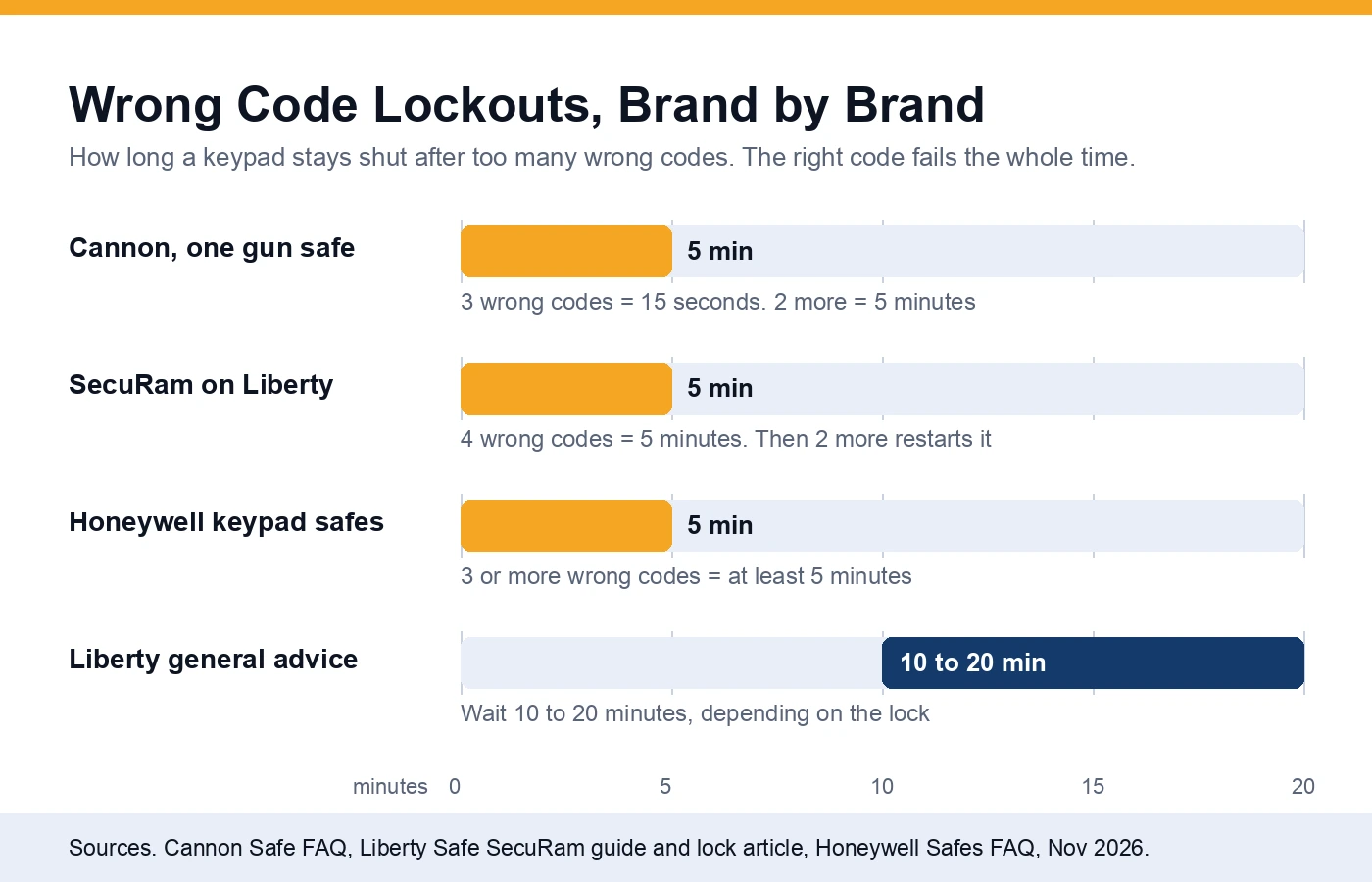
- SecuRam locks on Liberty safes. Liberty's SecuRam page says the fourth wrong code starts a 5 minute penalty. After it ends, just two more wrong codes start another 5 minutes, until a good code goes in.
- Cannon. The Cannon FAQ says one of its gun safes locks for 15 seconds after 3 wrong codes, then 5 minutes after 2 more. Pressing buttons during the lockout resets that timer.
- Honeywell. The Honeywell safes FAQ says 3 or more wrong codes block entry for at least 5 minutes, and only the emergency override key opens the safe during that time.
Liberty's general advice is to wait 10 to 20 minutes, depending on the lock. Set a timer, walk away, and do not touch the keypad. Then enter the code once, slowly.
3. Something Is Pushing on the Bolt
Guns, cases or a shelf can lean on the inside of the door. A door that sags or rubs the frame does the same. Liberty says that load can press on the side of the lock's own bolt, and a loaded bolt will not pull back.
Liberty's guide says to move the handle all the way to the locked position first, then enter a code that works. On direct drive locks, turn the keypad counterclockwise to its stop instead. The Cannon FAQ gives a similar tip for its locks. Turn the handle to the right and hold light pressure on it, enter the code, then turn it left. Once you hear 2 beeps, the safe should open.
4. The Handle Waited Too Long
A good code only opens a short window. Liberty says the lock relocks after a few seconds if the handle is not turned. Have your hand on the handle before the last digit, and turn as soon as the lock beeps.
5. The Handle Is Jammed at One End
If the handle was forced hard one way, it can bind before the code even goes in. Liberty's fix for this one is to find the middle of the handle's free play, let go, and enter the code again.
6. The Code Is Not Going In the Way You Think
Worn keys, a fast finger or a code that someone else changed can all look like a broken lock. Listen to the lock. Cannon says one long beep means the lock did not take the code, so slow down and try again. On a SecuRam lock, Liberty says 2 beeps means a good code and 3 beeps means a wrong one.
If you changed the code lately and something feels off, Liberty suggests trying your older codes, with time between tries so you do not trip a lockout.
7. A Part Inside Has Slipped or Failed
Sometimes the lock really does open and the bolts still do not move. A handle that spins freely, with no feel at all, points to a loose part between the handle and the bolts. The Cannon FAQ describes tightening the handle hub screws with a 5 mm Allen wrench, but that is a job for when the door is already open.
With the door shut, a loose linkage or a failed lock needs a safe technician. Cannon also notes that its warranty does not cover weak or dead batteries, so rule those out before you file a claim.
Lockout Times and Battery Rules by Brand
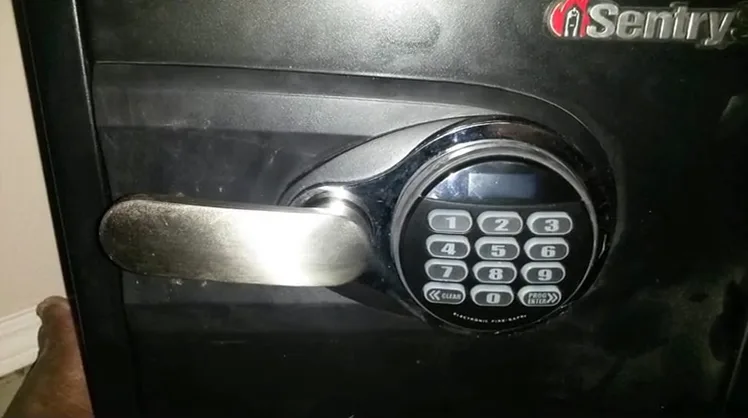
Battery advice from the makers does not agree, so follow your own brand. Using the wrong kind can cause the same no open problem you are trying to clear.
| Brand | Wrong code lockout | Battery the maker wants | How often to change it |
|---|---|---|---|
| Liberty | 5 minutes after 4 wrong codes on SecuRam locks. Wait 10 to 20 minutes on others | One 9 volt alkaline, such as Duracell or Energizer. No carbon | Every 6 to 12 months |
| Cannon | 15 seconds after 3, then 5 minutes after 2 more, on one gun safe lock | Alkaline Duracell or Energizer, no lithium, no rechargeables | Twice a year |
| Honeywell | At least 5 minutes after 3 or more | Most models take 4 AA, alkaline or lithium | At least once a year |
| SentrySafe | Not listed in the maker's FAQ | Name brand alkaline, no rechargeables. FP and FPW models take CR123 lithium | Replace all batteries at once |
The SentrySafe rules come from Master Lock's SentrySafe FAQ, which also says not to mix brands or mix old and new batteries. Cannon asks for batteries with an expiration date about 5 years out. SentrySafe asks for dates as close to 10 years out as you can find. Check the date on the pack before you buy.
What Not to Do While You Wait
- Do not force the handle. Liberty says plainly not to force it. Extra force adds the very bolt pressure that keeps the lock from opening.
- Do not pull the battery during a lockout. On SecuRam locks, Liberty says pulling the battery pauses the penalty timer. Put it back and the countdown picks up where it stopped.
- Do not keep entering codes. On a Cannon lock, pressing buttons resets the lockout timer. On a SecuRam lock, two more misses start a new 5 minute wait.
- Do not pry or drill. A pry bar bends the door and frame, and then the safe may never lock right again. If it still holds out, call someone who opens safes for a living.
Once a new battery gets you in, test the code with the door open before you close it again. Cannon's FAQ makes the same point after any battery change.
A Stuck Gun Safe in Oregon
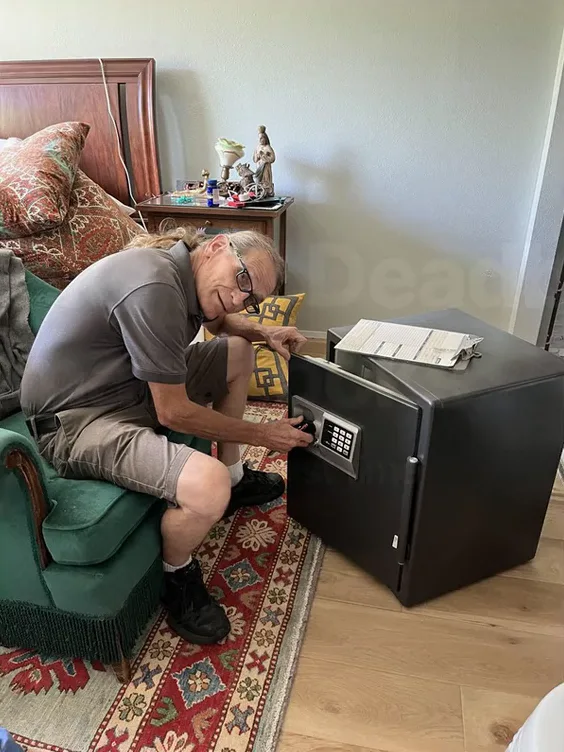
After a scare like this, some owners leave the gun safe open so they cannot get locked out again. In Oregon that can break the law. ORS 166.395 says a gun that is not carried by you or under your control has to be secured with an engaged trigger or cable lock, in a locked container, or in a gun room.
The same law says a gun is not secured if the key or combination is readily available to someone you have not allowed to have it. A violation is a Class C violation. It becomes a Class A violation if a minor gets the gun and you knew, or should have known, a minor could reach it. Each gun counts on its own.
So change the battery on a schedule instead, and keep a spare 9 volt or AA pack where you can find it. This is general information, not legal advice.
When a Safe Technician Is the Better Call
Call for help when a fresh alkaline battery, a full lockout wait, and the bolt pressure trick have all failed. Call sooner if the handle spins with no feel, the keypad stays dark with a new battery, or you need what is inside today.
ABC Lock and Safe has opened, repaired and moved safes in Portland since 1985. We work on almost any model, our goal is always to open it without damage, and we succeed in the large majority of cases. We carry the largest stock of safe parts in town, so most repairs happen the same day. Safe work is priced by the hour, so call with the brand and model and we will give you a range before we come out. If the maker is the better first call, we will tell you that too. See our safe unlocking and repair service, the safe types and brands we service, our guide to a lost SentrySafe key, or our safe installation guide for Portland.
Safe still will not open? Call (503) 766-5541, 24/7.
Pages Cited
Liberty Safe, What Happens to My Gun Safe When the Battery on the Electronic Lock Dies, November 2026
Liberty Safe, Common Problems With Electronic Safe Locks, November 2026
Liberty Safe, BackLit SecuRam Troubleshooting, November 2026
Cannon Safe, FAQ, November 2026
Honeywell Safes, Products FAQs, November 2026
Master Lock, SentrySafe FAQs, November 2026
ORS 166.395, Securing Firearms, November 2026