
Pick ABC Lock and Safe as a preferred source on Google
Most office managers think a Grade 1 lock is a high-security lock. It is not. Grade 1 is a durability rating. The Builders Hardware Manufacturers Association says a Grade 1 lock must survive one million open and close cycles. That proves it will last. It says nothing about who can copy your key or how long the lock holds against a drill. We install high-security cylinders in Portland offices, and that gap is the first thing we explain.
What Matters
- Grade 1 means tough, not secure. It is a strength and cycle rating under ANSI/BHMA A156.2.
- High security has its own standards. Look for UL 437 or ANSI/BHMA A156.30 on the cylinder.
- Key control is the part you pay for. A patented key cannot be cut from a blank sold at the hardware store.
- Patents run out. Ask the year your key system's patent ends before you buy.
- Not every door needs one. Put high security on the five doors below and keep the rest standard.
- In Oregon, the installer needs a state locksmith certificate. Check it before anyone touches your locks.
Grade 1 Is Strength. High Security Is Three More Things.
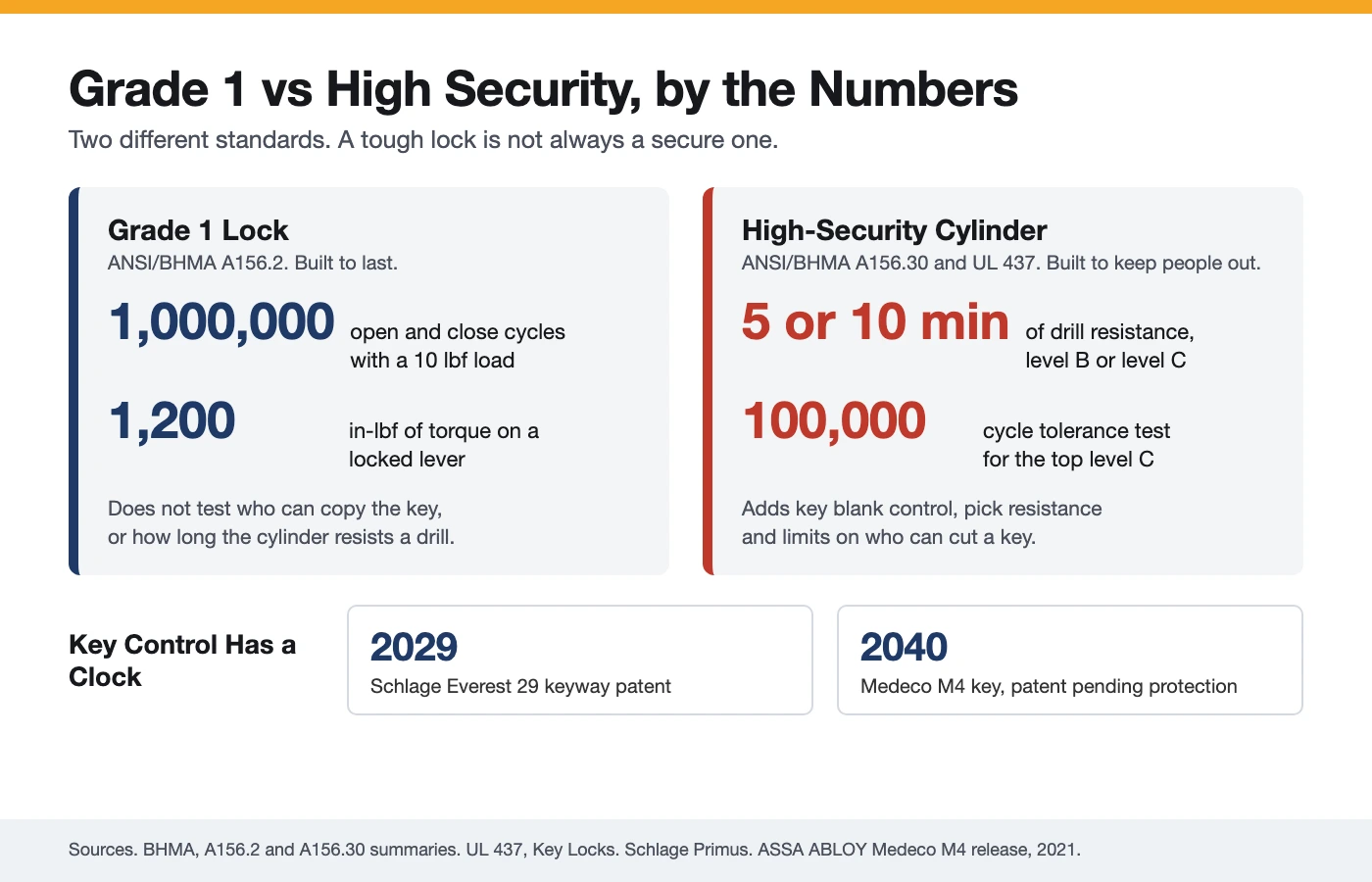
BHMA grades run from 1 to 3, with 1 the toughest. Under A156.2, a Grade 1 lock must pass one million cycles with a 10 pound load on it. The same standard sets seven abuse tests, including 1,200 inch pounds of torque on a locked lever. That is a lock that will not wear out on a busy front door.
A high-security cylinder is judged on other things. The BHMA summary of A156.30, the high-security cylinder standard, sorts the tests into three groups.
- Key control. Who can get a key blank, what may be marked on the cylinder, and for electronic cylinders, an audit trail. Each is rated at level A, B or C, and C is the highest.
- Destructive tests. Pulling the plug, hammering it out, forcing it with torque, and drilling it. Drill resistance is 5 minutes for level B and 10 minutes for level C.
- Surreptitious tests. Picking, decoding, a minimum number of key changes, and a 100,000 cycle tolerance test for level C. For electronic cylinders it adds magnets, over voltage and conductive liquids.
After the destructive tests, the lock must still refuse to turn without the right key.
The other mark to look for is UL 437, Key Locks. It covers door locks, standalone cylinders and other key locks. The current edition is the eighth, and it was reaffirmed as an American National Standard in January 2023. Makers list UL 437 on the cylinders that pass it, so ask to see it on the spec sheet.
The Two Standards Side by Side
| Mark | What it tests | Key number | What it does not tell you |
|---|---|---|---|
| ANSI/BHMA A156.2, Grade 1 | Life and strength of the lockset | 1,000,000 cycles | Who can copy the key |
| ANSI/BHMA A156.30, level B | Key control, attack and picking tests | 5 minute drill test | How long the patent lasts |
| ANSI/BHMA A156.30, level C | The same tests at the top level | 10 minute drill test, 100,000 cycle tolerance | How strong the door and frame are |
| UL 437, Key Locks | Listed resistance to physical and covert attack | 8th edition, reaffirmed 2023 | The grade of the lever or deadbolt around it |
A good office lock carries both kinds of marks. Grade 1 on the lockset, and UL 437 or A156.30 on the cylinder inside it.
Key Control Is What You Are Really Buying
A pick-proof lock does little if a fired employee can walk to a kiosk and copy the key. Key control stops that. The maker controls the blanks, and only authorized dealers can cut them for the people on your list.
That control rests on a patent, and a patent has an end date. Schlage says its Everest 29 keyways carry patent protection to the year 2029. Its Primus cylinders add a second sidebar and finger pin locking system, and they come in five levels of geographic exclusivity, so a key design can be held for one user locally or nationally.
When ASSA ABLOY announced the Medeco M4 in July 2021, it said the system was UL 437 listed and certified to A156.30. It said the key has a movable element meant to stop 3D printed copies, with patent pending protection until 2040.
A new office system bought in 2027 on a patent that ends in 2029 gives you about two years of real control. Ask the year before you sign.
Five Doors That Need One
You do not need a high-security cylinder on the break room. Allegion's key systems guide makes the same point. Apply high security only on the doors that need it, and save the budget on the rest. Start with these five.
1. The Server or Network Room
Allegion's guide uses this exact door as its top example. For a server room it recommends a Primus XP cylinder with UL 437, because client data is on the other side. One copied key here can cost more than every lock in the building.
2. The Main Entry and the Back Service Door
The front door gets the attention. The back door by the dumpster gets the old key from three tenants ago. Both are a way in from the street, so both get the same cylinder.
3. The Cash Office or Safe Room
Any room that holds a deposit bag, petty cash or a safe should not open to a key anyone can copy. Pair the cylinder with a reinforced strike, since the lock is only as strong as the frame it bolts into.
4. Records, HR and Medical Files
Personnel files, client contracts and patient records are the room people forget. If the files would hurt someone in the wrong hands, the door needs key control.
5. Every Door on the Top Level of a Master Key System
A grand master key opens most of the building. If it can be copied, the whole system can be copied. Put the restricted keyway at the top of the system, and read the master key system mistakes guide before you add levels.
Upgrade the Cylinder, Keep the Lock
Many offices do not need new hardware. A good Grade 1 lever or mortise lock can often take a high-security cylinder in place of the plain one.
Schlage says its Primus cylinders work inside an existing Schlage key system, and Primus keys still operate the standard cylinders on lower risk doors. That means you can upgrade five doors and keep one key ring. Its conventional cylinders come in formats for key-in-lever, rim and mortise locks.
Older Portland buildings often have mortise locks with a screw-in cylinder. Those take a high-security mortise cylinder well. If you are not sure what you have, see mortise lock vs cylindrical lock.
Two checks before you buy.
- Is the lockset itself Grade 1? A great cylinder in a weak lever can still be twisted off.
- Is the door frame solid? A long strike screw into the stud helps against a kick, and no cylinder can do that job.
Check the Locksmith Before the Lock
Oregon certifies locksmiths. The Oregon Construction Contractors Board says anyone who services, installs, repairs, rekeys or repins locks for pay needs a locksmith certificate. A license or certificate from another state does not count here. The certificate is tied to a CCB contractor license, so look up the business in the board's license search before you hand anyone your building keys.
For a high-security system, ask two more things. Is the locksmith an authorized dealer for that brand, and who holds the authorization card that lets someone order more keys?
When Your Office Is Ready for It
ABC Lock and Safe has served Portland since 1985 from our shop in Northeast Portland. We install high-security cylinders, set up restricted keyways and master key systems, and rekey whole offices the same day. We work with several major restricted keyway makers. Every locksmith and dispatcher on our team passes a background check, and we are licensed, bonded and insured. We are open 24/7, you get the price on the phone first, and we typically reach you in 15 to 30 minutes. See our commercial locksmith service for the full list.
Want the right doors upgraded? Call (503) 766-5541, 24/7.
Pages Cited
BHMA, A156.2 Locks and Latches, November 2026
BHMA, A156.30 High Security Cylinders, November 2026
UL Standards, UL 437 Key Locks, November 2026
Schlage, Primus Security Upgrade, November 2026
Allegion, Key Systems Guide, November 2026
SecurityInfoWatch, Medeco M4 Release, November 2026
Oregon Construction Contractors Board, Specialty Licenses, November 2026